
Building an Interest-Based Sales Nurture System Without Lead Magnets

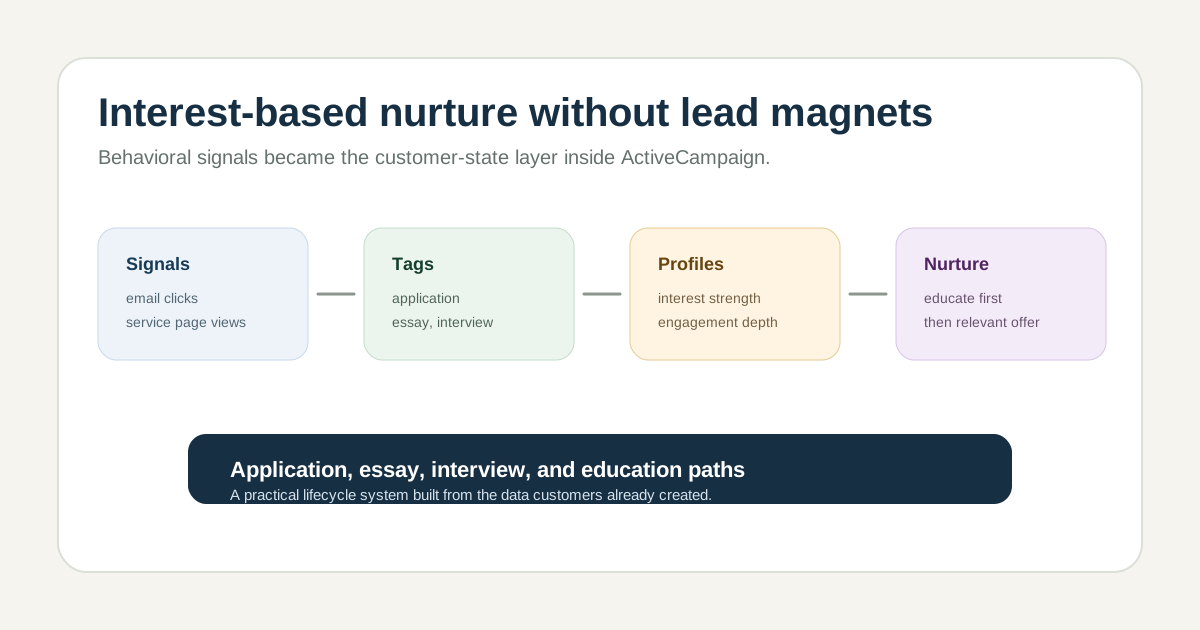
Table of contents
Introduction
Med School Headquarters sold educational services to aspiring medical students. The company had strong subject matter expertise, a founder-led brand, and multiple offers that served different moments in the medical school application journey.
The lifecycle problem was data.
The company wanted to nurture prospective customers toward the right educational service, but there was very little structured first-party intent data. Downloadable lead magnets would have made the job easier. Someone who downloaded an essay checklist likely cared about essays. Someone who downloaded an interview prep guide likely cared about interviews.
Those assets did not exist.
So the system had to use the signals already available: email clicks, website page views, and repeated engagement with specific topics.
This case study explains how I designed an interest-based sales nurture system in ActiveCampaign using behavioral data instead of waiting for perfect lead magnets.
Business context
Med School Headquarters sold educational services and products for aspiring medical students through Kajabi, with ActiveCampaign powering lifecycle marketing.
The offer set included:
- Medical school application support.
- Essay review.
- Interview preparation.
- Additional education products.
Each offer mapped to a different customer problem.
Someone looking for application support may be early in the process. Someone reading essay content has a more specific need. Someone viewing interview prep pages is likely closer to a time-sensitive purchase window.
The lifecycle system needed to separate those interests without asking every customer to fill out a long form.
Business problem
The company needed sales nurture that matched what each prospective customer cared about.
The default path would have been lead magnets:
- Application checklist.
- Essay review guide.
- Interview prep worksheet.
- Admissions timeline.
Each download would create a clean interest signal.
That would have been ideal. It was not available.
Waiting for new lead magnets would have delayed the lifecycle system. The better move was to ask a practical question:
What behavior already tells us what this person is interested in?The answer was already inside the customer journey:
- Which emails did they click?
- Which service pages did they view?
- Which topics did they return to?
- Which links did they ignore?
- Did their engagement concentrate around one offer category?
Those behaviors were not perfect. But they were good enough to begin building customer profiles.
Customer modeling
The customer model started with interest, not persona.
Instead of forcing every contact into a fixed buyer type, the system built a profile from demonstrated behavior.
Contact
  |
  +-- application interest
  +-- essay review interest
  +-- interview prep interest
  +-- other education product interest
  +-- engagement depth
  +-- purchase status
The important distinction was that an interest profile could change.
A student might first click application planning content, then later start clicking essay review content. Another student might ignore early application emails but repeatedly view interview preparation pages.
The system needed to keep enriching the profile as new engagement happened.
New click or page view
  |
  v
Evaluate topic
  |
  v
Apply or strengthen interest tag
  |
  v
Route or continue nurture
This made the lifecycle program responsive without requiring a perfect intake form.
Behavioral segmentation
The segmentation layer used actions customers already took.
Email clicks became one signal.
Clicked essay email link
  |
  v
Apply tag: interest_essay_review
Page views became another signal.
Viewed interview prep page
  |
  v
Apply tag: interest_interview_prep
Repeated engagement created a stronger signal.
If contact has:
  interest_essay_review
  and clicked two essay-related emails
  and viewed essay service page

Then:
  prioritize essay review nurture
The system did not need to pretend that one click proved purchase intent. A single behavior could start enrichment. Repeated behavior could drive routing.
That was the main design principle: let the customer's behavior build the profile over time.
ActiveCampaign implementation
ActiveCampaign became the customer-state layer.
The implementation relied on a few practical building blocks:
- Tags for demonstrated interests.
- Link click triggers for email engagement.
- Site tracking or page-view tagging for important service pages.
- Automations that enrolled contacts into the right nurture journey.
- Suppression rules so contacts did not receive conflicting sales pushes.
- Purchase or customer status checks before sending offers.
The tag structure needed to be clear enough to maintain.
interest_application_support
interest_essay_review
interest_interview_prep
interest_education_product

engaged_application_support
engaged_essay_review
engaged_interview_prep

customer_application_support
customer_essay_review
customer_interview_prep
The exact naming mattered less than the logic. Tags had to separate interest, engagement depth, and customer status.
If those states get mixed together, automations become hard to reason about.
Tagging strategy
The tagging strategy had three layers.
The first layer captured topic interest.
Clicked a link about essays
Viewed the essay review page
Clicked a testimonial tied to essay review

Apply:
  interest_essay_review
The second layer captured engagement strength.
If contact has interest_essay_review
and performs another essay-related action:
  apply engaged_essay_review
The third layer protected the customer experience.
If contact purchases essay review:
  apply customer_essay_review
  remove from essay sales nurture
  move into post-purchase support or cross-sell path
This created a lightweight state model:
unknown
  |
  v
interested
  |
  v
engaged
  |
  v
offer eligible
  |
  v
customer
The purpose was not to create a complicated scoring model. The purpose was to stop treating every prospective student the same.
Sales nurture architecture
Each service category received its own nurture path.
Application support interest
  |
  v
Application education journey
  |
  v
Application offer

Essay review interest
  |
  v
Essay education journey
  |
  v
Essay review offer

Interview prep interest
  |
  v
Interview education journey
  |
  v
Interview prep offer

Other education product interest
  |
  v
Product-specific education journey
  |
  v
Relevant offer
Each path followed the same philosophy.
Educate first. Sell after the customer continued engaging.
That mattered because aspiring medical students were making high-trust decisions. They were not buying a small impulse product. They needed confidence, clarity, and proof that the service matched their situation.
Journey branching
The journeys branched based on demonstrated interest and ongoing engagement.
on email click or page view:
  topic = classify_behavior(event)
  apply_interest_tag(contact, topic)

  if contact has active customer tag for topic:
    do not enter sales nurture

  else if contact is already in matching nurture:
    continue current journey

  else if contact is in conflicting sales nurture:
    evaluate priority
    route to strongest demonstrated interest

  else:
    enter topic-specific nurture
The branching rule was practical: do not create a new journey every time a contact clicks something.
A contact can have multiple interests. The system needed to decide which interest deserved priority without making the automation unmanageable.
The cleaner approach was to use recent and repeated behavior as a stronger signal than a one-time click.
priority = repeated topic engagement + service page views + recencyThat kept the automation focused.
Why education came before promotion
Education needed to come first because the customer was making a decision with high personal stakes.
Medical school applicants are not only comparing services. They are worried about making the wrong move in a process that can shape their future.
A generic promotion skips the trust-building stage.
The better sequence was:
Identify interest
  |
  v
Teach the problem
  |
  v
Explain the stakes
  |
  v
Show how to think about the decision
  |
  v
Offer the relevant service
That approach made the commercial offer feel connected to the customer's behavior.
If someone kept engaging with interview prep content, the interview prep offer was not random. It matched their demonstrated concern.
Automation logic
The simplified logic looked like this:
function handleBehavior(contact, event):
  topic = classify(event)

  if topic is null:
    return

  addTag(contact, "interest_" + topic)
  incrementEngagement(contact, topic)

  if hasPurchased(contact, topic):
    suppressSalesNurture(contact, topic)
    return

  if engagementScore(contact, topic) >= threshold:
    addTag(contact, "engaged_" + topic)

  if not inJourney(contact, topic):
    enterNurture(contact, topic)
The implementation did not depend on a perfect data model.
It depended on consistent tagging, clear entry rules, suppression logic, and regular QA.
Tradeoffs
The biggest tradeoff was signal quality.
A lead magnet gives a cleaner declared-interest signal. A click or page view is noisier. Someone might click out of curiosity. Someone might view a service page without being ready to buy.
The solution was to avoid overreacting to one action.
Single behavior could enrich the profile. Repeated behavior could route the contact into a stronger nurture path.
The second tradeoff was operational complexity.
Behavioral tags make automation more relevant, but they can also create clutter if naming rules are loose. The system needed a disciplined tag taxonomy so ActiveCampaign did not turn into a pile of half-overlapping labels.
The third tradeoff was measurement.
Without clean lead magnets and source-specific funnels, attribution would never be as clean as a controlled test. The lifecycle system still needed tracking so the team could see which interests, journeys, and offers were creating movement.
Lessons learned
You can build useful lifecycle systems before the data is perfect.
Lead magnets would have helped, but their absence did not block the work. Customers were already creating behavioral signals through clicks and page views.
Interest beats generic nurture. A student who engages with essay content should not receive the same sales path as someone researching interviews.
Tags are a state model. In ActiveCampaign, tags can become the closest thing to a customer-state layer if they are named and governed properly.
Education earns the right to sell. For high-trust educational services, nurture should help the customer understand the problem before asking for a purchase.
Behavioral enrichment should be continuous. A contact's first signal is rarely the whole story. The system gets better as more engagement accumulates.
Closing thoughts
The Med School Headquarters nurture system was built around a practical constraint: ideal first-party data did not exist yet.
Instead of waiting, I used the signals customers were already generating. Email clicks. Important page views. Repeated engagement with specific topics.
Those signals became interest profiles. The profiles became ActiveCampaign journeys. The journeys educated first, then introduced relevant offers after customers showed continued engagement.
That is the core lifecycle lesson: useful systems can start with imperfect data if the architecture respects customer behavior.
Get one retention idea, every other week
The Lifecycle Letter. One actionable retention idea in your inbox, no fluff, unsubscribe anytime.