
Designing a 160-Mile Geo-Targeted Tournament Promotion System for Pickleball.com

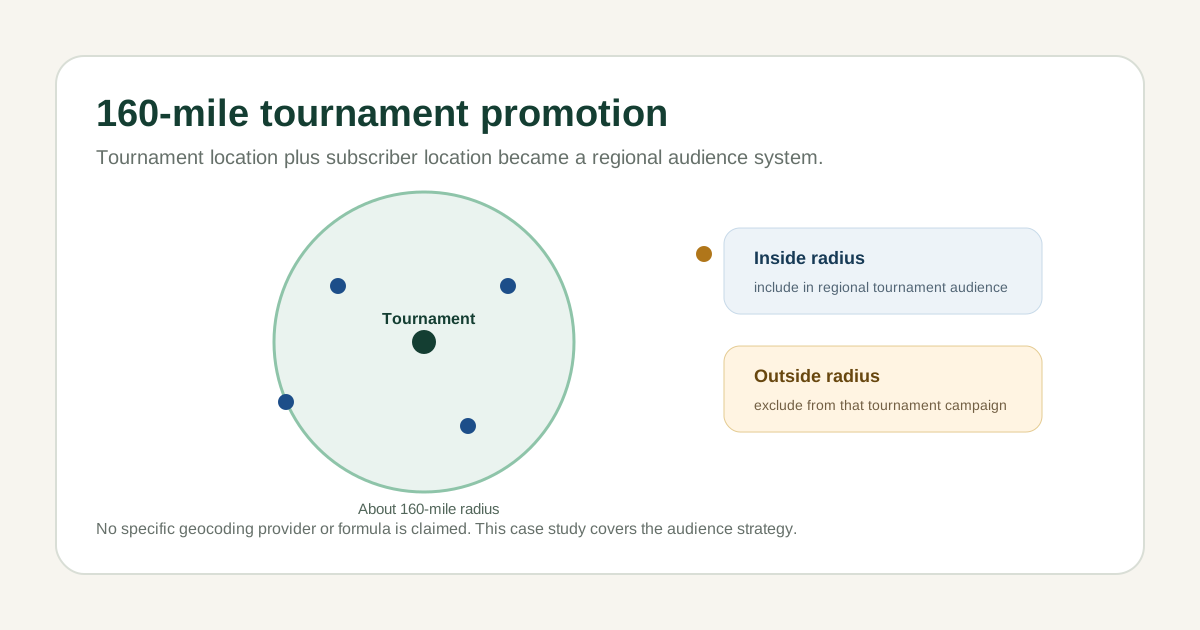
Table of contents
- Executive summary
- National audience, local event problem
- Why broad tournament sends were inefficient
- Designing the 160-mile audience strategy
- Data and segmentation workflow
- Regional audience decision tree
- Campaign operations
- Customer-experience implications
- National broadcast versus regional targeting
- Limitations and edge cases
- Opportunities for expansion
- Lessons learned
Executive summary
Pickleball.com and the PPA Tour promoted tournaments across different cities and regions.
A national subscriber database is valuable, but a local event is not equally relevant to every subscriber. A tournament in one market matters most to players and fans close enough to attend.
I used location data to identify subscribers within about 160 miles of each tournament and send regional tournament promotions to the people most likely to care.
This case study is the business and operations version of the work. The separate Customer.io article explains location-aware personalization mechanics. This one explains the 160-mile audience strategy.
National audience, local event problem
The subscriber database included players and fans across many markets.
That created a basic relevance problem.
A tournament in Arizona may be highly relevant to people in Arizona and nearby regions. It is much less relevant to someone across the country, unless the event has national importance.
If every event gets promoted to the full database, the program creates several problems:
- Low geographic relevance.
- Excessive campaign frequency.
- Audience fatigue.
- Lower engagement.
- Poor customer experience.
- Harder operations when multiple tournaments need promotion.
The database needed to behave more like a regional audience system.
Why broad tournament sends were inefficient
Broad sends are tempting because they are easy.
They also ignore the nature of tournament participation.
Players have practical constraints:
- Distance.
- Travel time.
- Local interest.
- Schedule.
- Skill level.
- Event type.
Location is not the only signal, but it is one of the clearest signals for event relevance.
The better question was:
Who lives close enough for this tournament to be a reasonable opportunity?That question turned location into lifecycle logic.
Designing the 160-mile audience strategy
I used a radius of about 160 miles around each tournament location.
That threshold was practical, not universal. It was large enough to include:
- Local residents.
- Nearby regional players.
- Fans willing to make a reasonable drive.
- Adjacent metropolitan areas.
The conceptual logic was:
Tournament location
  +
Subscriber location
  |
  v
Determine proximity
  |
  v
Is subscriber within about 160 miles?
  |
  +-- yes: include in regional tournament audience
  |
  +-- no: exclude from that campaign
No specific geocoding provider, SQL formula, or distance-calculation method is claimed here. The confirmed strategy was the 160-mile geographic targeting model.
Data and segmentation workflow
The campaign workflow used two inputs:
- Tournament-location data.
- Subscriber-location data.
The operating model looked like this:
Tournament added to calendar
  |
  v
Identify tournament city and region
  |
  v
Use subscriber-location data
  |
  v
Build audience within about 160 miles
  |
  v
Send tournament-specific promotion
  |
  v
Repeat for other tournament markets
That turned each tournament into a regional campaign instead of a national broadcast by default.
Regional audience decision tree
The decision tree was intentionally simple.
Subscriber has usable location?
  |
  +-- no:
  |     apply fallback rule or exclude from regional send
  |
  v
Subscriber within tournament radius?
  |
  +-- yes:
  |     include
  |
  +-- no:
        exclude
The fallback rule depends on the business goal.
For a strict regional campaign, missing location can mean exclusion. For a nationally important event, missing location might be handled differently. The important thing is to define the rule before launch.
Campaign operations
The 160-mile model had to work across a tournament calendar.
The campaign process included:
- Identifying the tournament location.
- Building or selecting the nearby audience.
- Confirming the promotion window.
- Checking for overlapping events.
- Managing send frequency.
- QAing audience inclusion and exclusion.
- Sending the tournament promotion.
- Repeating the process for future events.
The operating workflow looked like this:
Event calendar review
  |
  v
Tournament selected for promotion
  |
  v
Regional audience created
  |
  v
Campaign timing confirmed
  |
  v
Frequency and overlap check
  |
  v
Send and monitor
This allowed the team to promote more events without treating every send as a full-database announcement.
Customer-experience implications
Geographic targeting improves the customer experience because it respects context.
A subscriber should not feel like every tournament in the country is being pushed at them. They should receive events that feel plausible.
That improves:
- Message relevance.
- Perceived usefulness.
- Audience trust.
- Database health.
- Sponsor value.
- Tournament awareness in the right markets.
This also helps when several tournaments are active at once. Regional targeting reduces unnecessary overlap and gives each event a more realistic audience.
National broadcast versus regional targeting
The before-and-after operating model looked like this:
National broadcast model
  tournament promotion
  |
  v
  full database
  |
  v
  high reach, low local relevance

Regional targeting model
  tournament promotion
  |
  v
  about 160-mile audience
  |
  v
  lower reach, higher practical relevance
The tradeoff is obvious.
You sacrifice some reach to improve relevance. For event promotion, that tradeoff usually makes sense.
Limitations and edge cases
The model had practical limitations.
Location data can be missing, outdated, or imprecise. A person may live outside the radius but still be willing to travel. Someone inside the radius may not be interested in that event. Tournament markets can overlap. Border regions can create strange inclusion decisions.
There are also operational edge cases:
- Multiple tournaments near the same subscriber.
- Late-added events.
- Missing tournament location data.
- Subscribers with vague or incomplete location data.
- National events that deserve broader promotion.
- Frequency caps when several events overlap.
A mature system needs rules for those cases.
Opportunities for expansion
The 160-mile model could be extended with more signals:
- Skill level.
- Past registration history.
- Tournament interest.
- Event type.
- Travel behavior.
- Email engagement.
- Sponsor relevance.
The radius model is the base layer.
The more advanced version combines geography with player intent.
Location relevance
  +
Tournament interest
  +
Player history
  |
  v
Better event audience
Lessons learned
Location can be a real lifecycle signal.
It is not fancy. It is not machine learning. It is just a practical attribute that maps cleanly to event relevance.
The value came from turning that attribute into a repeatable operating model. Tournament location plus subscriber location became a regional audience system.
That is lifecycle architecture in plain clothes: use the customer data you have, define the decision rule, and make the communication match the situation.
Get one retention idea, every other week
The Lifecycle Letter. One actionable retention idea in your inbox, no fluff, unsubscribe anytime.