
How I Accidentally Built an Email Newsletter Into One of Pickleball's Largest Owned Media Channels

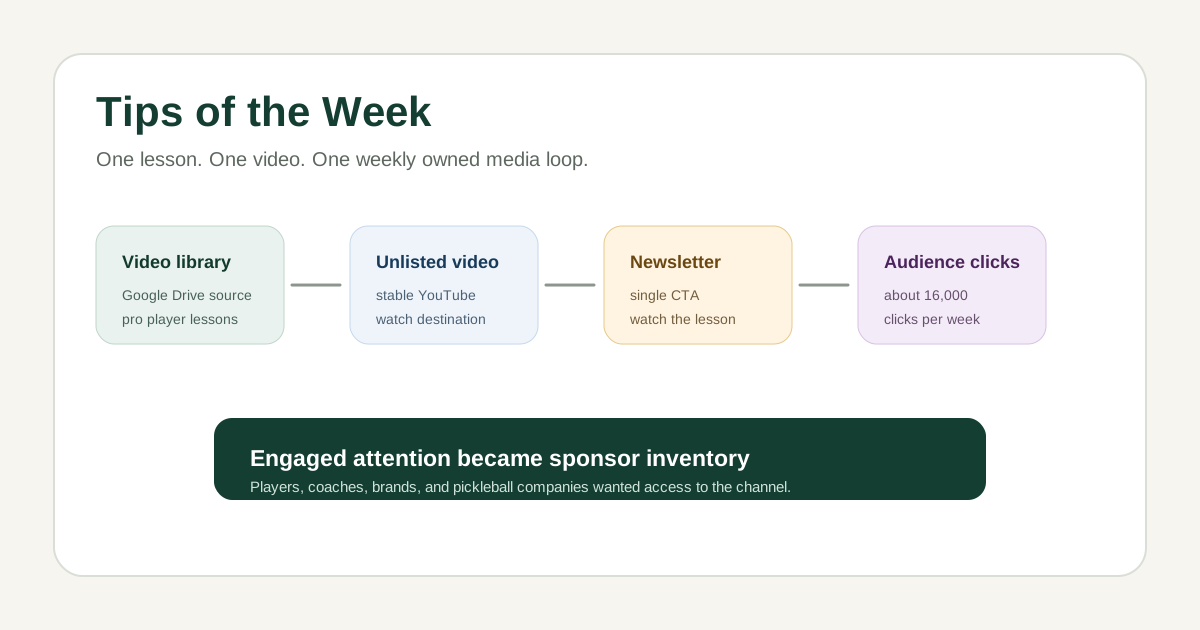
Table of contents
- Introduction
- Business context
- Business problem
- Why the single-action model mattered
- Solution architecture
- Weekly production workflow
- Content pipeline
- Newsletter architecture
- Distribution workflow
- Engagement flywheel
- Media business evolution
- Simplified automation logic
- Engineering decisions and tradeoffs
- Lessons learned
- Closing thoughts
Introduction
Pickleball.com had a large email audience, but a large list does not automatically become an owned media channel.
The audience needed a reason to keep paying attention between purchases. Tournament pushes, product promos, and company updates could create short bursts of activity, but they did not create a weekly habit.
I proposed a recurring educational franchise called Tips of the Week.
The idea was simple: every edition should provide enough value that subscribers would want to open it again the next week. The first objective was not product sales. It was one action: get the reader to watch a useful instructional pickleball video.
That constraint shaped the whole system.
The newsletter started as a lifecycle engagement idea. Over time, it became something bigger. The series eventually generated approximately 16,000 clicks per week. Professional players, coaches, pickleball brands, and other companies wanted placement because the newsletter had become a dependable way to reach an engaged pickleball audience.
This case study breaks down how a simple educational email turned into an owned media asset.
Business context
Pickleball.com had access to an audience with clear interest in the sport. The company also had a library of instructional content from professional pickleball players stored in Google Drive.
That created an opportunity.
The company did not need another generic newsletter. It needed a repeatable content system that could train subscribers to expect something useful every week.
The core business context looked like this:
- A large email audience already existed.
- The audience needed value between purchase moments.
- The company had instructional videos from credible players.
- Email could distribute that content without depending on social algorithms.
- A repeatable franchise could become valuable to players, coaches, brands, and sponsors.
The goal was to convert attention into habit.
Business problem
Promotional email has a natural ceiling.
If every send asks the audience to buy something, register for something, or click into a commercial offer, engagement becomes conditional. The subscriber only opens when they are already in market.
Pickleball.com needed a reason for people to engage when they were not actively buying.
Education solved that problem because the value exchange was cleaner. The reader did not have to be ready to purchase. They only had to want to improve at pickleball.
That shifted the job of the email from promotion to distribution.
The newsletter needed to answer one question every week:
What is the one lesson worth watching this week?Everything else was secondary.
Why the single-action model mattered
The strongest decision was narrowing the email around one primary action.
The objective was not:
- Click three articles.
- Browse a store.
- Register for an event.
- Read a long newsletter.
- Choose between multiple competing CTAs.
The objective was:
Watch the featured instructional video.That made the customer experience easier to understand.
The reader opened the email, saw the lesson, understood the benefit, and clicked to watch. The email did not need to carry the full educational burden. It needed to package the lesson clearly enough that the subscriber wanted to continue.
This matters because every extra CTA creates decision cost. A weekly education franchise gets stronger when the pattern is predictable.
Open email
Read the lesson framing
Click the video
Watch the instruction
Come back next week
The repeatable action was the product.
Solution architecture
Tips of the Week was built as a simple content operation with clear inputs, outputs, and constraints.
Video library
  |
  | select one lesson
  v
Unlisted YouTube upload
  |
  | create stable video destination
  v
Newsletter build
  |
  | frame the lesson around one benefit
  v
Email distribution
  |
  | send to owned audience
  v
Engagement data
  |
  | clicks, interest, sponsor demand
  v
Next edition planning
The architecture was intentionally lightweight.
The company already had the raw content. The main system work was creating a repeatable workflow around selection, packaging, publishing, and distribution.
The newsletter did not need a complicated recommendation engine at the start. It needed editorial consistency and operational discipline.
Weekly production workflow
The weekly workflow turned a content library into a predictable audience product.
Monday
  Review available instructional videos
  Select the strongest lesson for the week

Tuesday
  Upload the video to YouTube as Unlisted
  Confirm playback and link stability

Wednesday
  Write the email around the lesson
  Build the email with one primary CTA

Thursday
  QA the email
  Confirm links, preview, mobile rendering, and tracking

Send day
  Publish the newsletter
  Monitor clicks and engagement

Post-send
  Review performance
  Capture learnings for future editions
That process made the newsletter repeatable.
A recurring franchise only works if production can keep up with the promise. The audience learns the cadence. The team learns the workflow. Sponsors learn where the placement sits. Players learn what kind of content gets featured.
Consistency created inventory.
Content pipeline
The content pipeline started with assets the company already owned.
Videos lived in Google Drive. They came from professional pickleball players and instructional contributors. That meant the content already had authority. The missing piece was distribution.
The pipeline looked like this:
Google Drive
  - raw instructional videos
  - player or coach content
  - lesson topics

Editorial selection
  - choose one useful lesson
  - confirm relevance to broad audience
  - avoid overcrowding the edition

YouTube
  - upload as Unlisted
  - create the watch destination
  - keep the experience simple

Newsletter
  - write the lesson framing
  - build around one CTA
  - track clicks
Uploading videos as unlisted YouTube links solved a practical distribution problem. The video had a stable destination, the email had a clean CTA, and the content could be shared without turning every edition into a custom landing-page build.
Newsletter architecture
The newsletter had one job: package the video so the reader understood why it was worth watching.
The architecture was intentionally simple.
Subject line
  - promise the specific lesson

Opening
  - name the problem or skill

Lesson framing
  - explain what the player will learn
  - keep the copy tight

Primary CTA
  - watch the video

Optional sponsor placement
  - relevant, contained, clearly secondary

Footer
  - standard compliance and brand elements
The email copy supported the video. It did not compete with it.
That distinction mattered. A content franchise becomes easier to trust when the audience knows exactly what they are getting.
Distribution workflow
The distribution workflow depended on owned audience access.
Social platforms can create reach, but they can also bury content. Email gave Pickleball.com a direct line to people who had already expressed interest in the sport.
Owned audience
  |
  | weekly newsletter send
  v
Instructional video
  |
  | click and watch behavior
  v
Audience engagement signal
  |
  | validates the franchise
  v
Player, coach, brand, and sponsor demand
The weekly send created a recurring distribution moment. That made the newsletter useful to subscribers first, then useful to outside partners later.
The order mattered.
If the newsletter had started as a sponsorship product, it would have been weaker. The audience value came first. The media value followed.
Engagement flywheel
The flywheel was built around usefulness.
Useful lesson
  |
  v
Subscriber clicks
  |
  v
Higher engagement
  |
  v
More proof the audience cares
  |
  v
Players and coaches want to be featured
  |
  v
Better instructional content
  |
  v
More useful lessons
As the series grew, it attracted better supply.
Professional players and coaches wanted their instructional content featured because the newsletter had reach. Brands and pickleball companies wanted placement because the audience was engaged. Sponsored placements became a revenue stream because the newsletter had become an asset with predictable attention.
The channel became valuable because it was trusted.
Media business evolution
The shift from lifecycle email to owned media property happened gradually.
At first, Tips of the Week existed to keep subscribers engaged. The success metric was attention on educational content.
Then the newsletter created secondary value:
- Players wanted visibility.
- Coaches wanted their lessons watched.
- Brands wanted placement.
- Sponsors wanted access to a relevant audience.
- Pickleball companies saw the newsletter as distribution.
That changed the role of the email program.
It was no longer only supporting lifecycle engagement. It had become a media surface inside the pickleball ecosystem.
The confirmed result was significant: the newsletter eventually generated approximately 16,000 clicks per week.
That number mattered because it represented recurring audience action. Not a one-time campaign spike. A weekly behavior.
Simplified automation logic
The workflow was not complicated. That was the point.
for each weekly edition:
  video = select_video(google_drive_library)
  youtube_url = upload_unlisted(video)

  email = build_newsletter(
    lesson = video.lesson,
    primary_cta = youtube_url,
    sponsor_block = optional_relevant_placement
  )

  qa(email)
  send(email)
  record_clicks(email)

  if sustained_click_volume grows:
    package newsletter as sponsor inventory
    invite player and coach submissions
The technical lesson is that lifecycle architecture is not always about complex branching.
Sometimes the system is an operational loop:
Content supply
Packaging
Distribution
Engagement
Partner demand
Better supply
The loop has to be clear enough that the team can run it every week.
Engineering decisions and tradeoffs
The first tradeoff was depth versus focus.
The email could have included several lessons, multiple articles, tournament links, and store modules. That would have created more surfaces to click. It also would have made the weekly habit less clear.
I chose focus. One lesson. One video. One primary CTA.
The second tradeoff was speed versus production polish.
Building custom landing pages for every lesson would have created more control, but it would have slowed the workflow. Unlisted YouTube links gave the team a stable destination and kept production moving.
The third tradeoff was editorial consistency versus promotional flexibility.
A newsletter built around education cannot become a disguised ad every week. Sponsored placements had to fit around the audience promise. The content had to stay useful or the media value would decay.
That is the tension with owned media. The same attention that makes sponsorship valuable can disappear if the audience stops trusting the product.
Lessons learned
Owned media starts with audience value.
The newsletter became commercially valuable because readers had a reason to click before sponsors showed up. That order matters.
A recurring franchise is stronger than isolated campaigns. An isolated campaign asks the audience to care once. A franchise teaches the audience what to expect.
One primary action reduces friction. The newsletter asked readers to watch the featured video. The system became easier to write, easier to QA, easier to measure, and easier for subscribers to understand.
Operational systems create strategic assets. Google Drive, YouTube, weekly email production, tracking, and sponsor placement rules were not glamorous. Together, they created a repeatable distribution channel.
Lifecycle can create media properties. Email is often treated as a conversion channel. In this case, it became an audience product that created value for subscribers, players, coaches, brands, and the business.
Closing thoughts
Tips of the Week worked because it respected attention.
The audience did not need another promotional newsletter. They needed a useful reason to come back.
The company already had content. The missing system was a repeatable way to package and distribute it.
By focusing every edition on one instructional video, the newsletter created a habit. That habit turned into reach. The reach attracted players, coaches, brands, and sponsors.
That is how a lifecycle email became an owned media channel.
Get one retention idea, every other week
The Lifecycle Letter. One actionable retention idea in your inbox, no fluff, unsubscribe anytime.