Designing Behavior-Based Onboarding Around Leading Indicators of Retention

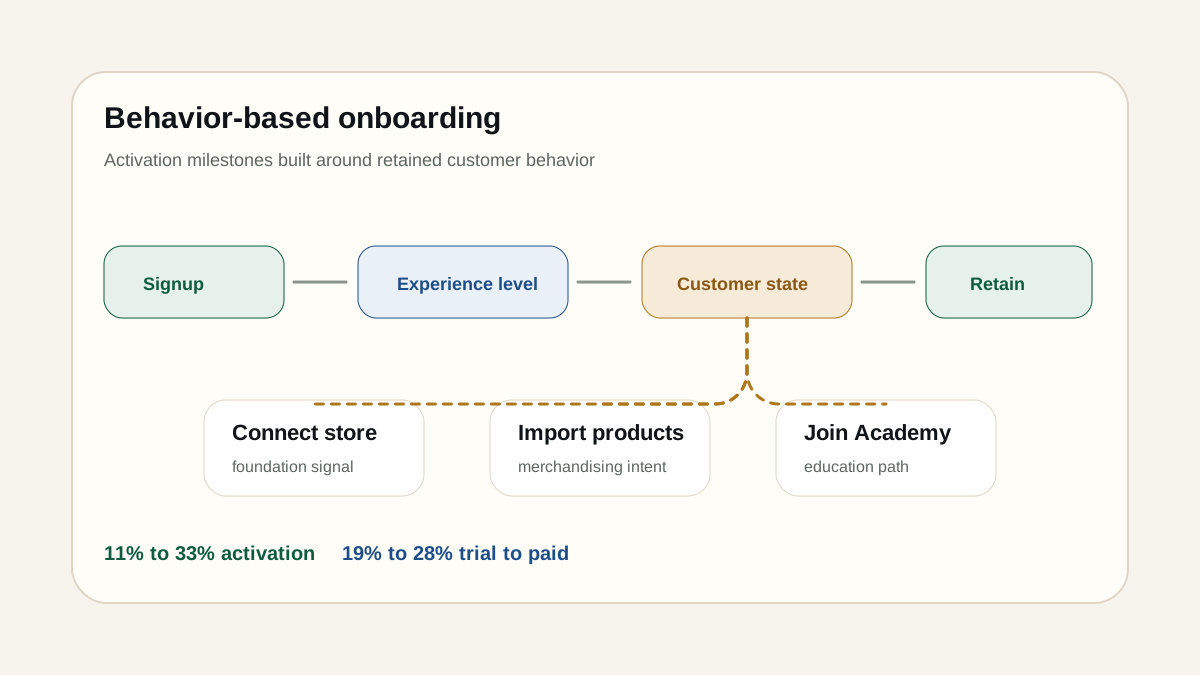
Table of contents
Introduction
Zendrop's onboarding problem looked like a trial conversion problem at first.
The company could get users into trials, but a trial start did not mean the user had reached real product momentum. A customer could start a trial, look around, fail to connect a store, fail to import products, skip the education layer, and still count as a successful acquisition event in the short term.
That created a weak measurement model. It optimized for the moment someone entered the business instead of the behaviors that made them more likely to stay.
This case study explains how I redesigned Zendrop's onboarding around leading indicators of retention: connecting a store, importing products, and joining Zendrop Academy. The work was less about writing a better welcome sequence and more about building a lifecycle architecture that treated onboarding as a customer state machine.
Business Problem
Zendrop served a beginner-heavy ecommerce audience. Many users were not only learning Zendrop. They were learning dropshipping, product selection, store setup, fulfillment, and the operating model behind an online business.
Optimizing only for trial starts created a short-term win and a long-term problem. Trial conversion could look healthy while downstream churn stayed high because users had not reached the behaviors that predicted long-term value.
The true customer outcome was not "started a trial." It was closer to "made a sale." But in dropshipping, that moment can take weeks or months. Lifecycle could not wait for that lagging event before deciding whether onboarding was working.
The program needed smaller, earlier signals that showed a user was actually moving toward a successful store.
The key question changed from:
Did the user start a trial?to:
Has the user completed the product behaviors that retained customers tend to complete?Why Native Platform Features Weren't Enough
A normal welcome sequence can send a fixed set of emails after signup. That was not enough for this problem.
Zendrop needed onboarding that responded to customer state. A beginner who had not connected a store needed a different path than an experienced seller who had already connected Shopify but had not imported products. A user who completed a milestone should not keep receiving reminders for that same milestone.
The platform could send email. The harder part was the logic model:
- Collect experience level at the beginning.
- Read product behavior after signup.
- Decide which milestone was incomplete.
- Send the right education, reminder, and support sequence.
- Congratulate users when a milestone was completed.
- Move users into the next lifecycle stage automatically.
That is not a campaign calendar. It is a state system.
Solution Architecture
The first step was analyzing retained customers and the behaviors they completed before becoming valuable users.
Three leading indicators stood out:
- Connecting a store
- Importing products
- Joining Zendrop Academy
Each one represented a different kind of progress.
Connecting a store meant the user had linked Zendrop to the commerce surface where value could happen. Importing products meant the user was moving from exploration into merchandising intent. Joining Zendrop Academy meant the user had entered the education path that could help them avoid beginner mistakes.
Those became activation milestones.
Signup
  |
  v
Experience-level capture
  |
  v
Customer state evaluation
  |
  +-- Store not connected -> Store connection milestone
  |
  +-- Product not imported -> Product import milestone
  |
  +-- Academy not joined -> Academy milestone
  |
  v
Completed milestone event
  |
  v
Congratulation + next lifecycle stage
The architecture separated customer identity, customer state, milestone logic, and messaging. That made the system easier to change because the onboarding emails were no longer the source of truth. The user's product behavior was.
Technical Implementation
The onboarding flow began by collecting customer experience level through a form. The goal was not to create a vanity personalization field. The goal was to decide how much explanation the user needed.
The primary experience groups were:
- Beginners who needed foundational education.
- Previously unsuccessful sellers who needed confidence and a cleaner path.
- Experienced sellers who wanted faster setup and less hand-holding.
The milestone system then checked whether the user had completed key product actions.
if store_connected == false:
  active_milestone = "connect_store"
else if product_imported == false:
  active_milestone = "import_product"
else if academy_joined == false:
  active_milestone = "join_academy"
else:
  active_milestone = "activated"
Each milestone used a three-email cadence:
- Education: explain why the milestone mattered.
- Reminder: bring the user back to the incomplete action.
- Support: reduce confusion and offer help.
The important detail was that the cadence was milestone-specific. Store connection, product import, and Academy participation were not treated as interchangeable actions. Each milestone had its own objection pattern and education requirement.
When a user completed a milestone, the system congratulated them and moved them forward.
event: store_connected
  update store_connected = true
  exit connect_store reminder path
  send milestone complete message
  evaluate next milestone
That prevented the common lifecycle failure where a customer completes an action and still receives "please do the thing" emails afterward.
Evergreen Nurture Layer
Onboarding did not end after the first sequence.
Users who moved beyond the initial flow still needed reinforcement. That became the evergreen nurture system. Educational content could continue teaching useful ecommerce concepts while dynamic CTA blocks reinforced the user's incomplete milestones.
Render educational email
  |
  v
Evaluate customer state
  |
  +-- store_connected = false -> Connect store CTA
  +-- product_imported = false -> Import product CTA
  +-- academy_joined = false -> Academy CTA
  +-- all complete -> next-stage CTA
This let one evergreen nurture system adapt without maintaining separate versions of the same content for every user type.
The educational body could stay stable. The action block could change based on product state.
Engineering Decisions and Tradeoffs
The biggest decision was to use product behavior as the organizing principle instead of email timing.
That made the system more accurate, but it also required cleaner event tracking and stronger QA. If a store connection event failed to update, the user could stay trapped in the wrong milestone path. The architecture depended on reliable product-state data.
The second decision was to use milestones instead of trying to predict the final outcome directly. A sale was the real business result, but it was too delayed to use as the first onboarding control point. The better model was to move users through behaviors that made a future sale more likely.
The third decision was to separate experience-level messaging from milestone logic. A beginner and an experienced seller might both need to connect a store, but the explanation should not be identical.
Measured Results
The onboarding rebuild produced two measured improvements:
- Lifecycle-attributed activation increased from 11% to 33%.
- Trial-to-paid conversion improved from approximately 19% to 28%.
The broader lesson was that onboarding became stronger when it stopped treating signup as the goal. Signup was the entry point. Activation required evidence that the user was moving through the behaviors that mattered.
Lessons Learned
Activation should be modeled around behaviors, not feelings.
A customer can be interested without being activated. They can start a trial without being ready to succeed. They can open emails without taking the product actions that create value.
The useful lifecycle question is:
What has this customer done, what have they not done, and what should the system ask them to do next?That framing turned onboarding from a fixed sequence into a state-aware lifecycle architecture.
Closing Thoughts
Zendrop's onboarding improved because the system started measuring progress before the final outcome arrived.
Connecting a store, importing products, and joining Academy gave the lifecycle program earlier signals to work with. Those milestones made the journey easier to personalize, easier to measure, and easier to improve over time.
The real work was not sending more onboarding messages. It was defining the customer states that mattered and building a system that could move people through them.
Get one retention idea, every other week
The Lifecycle Letter. One actionable retention idea in your inbox, no fluff, unsubscribe anytime.