
Designing a Product-Qualified Lead Routing System Using Shopify Revenue Signals

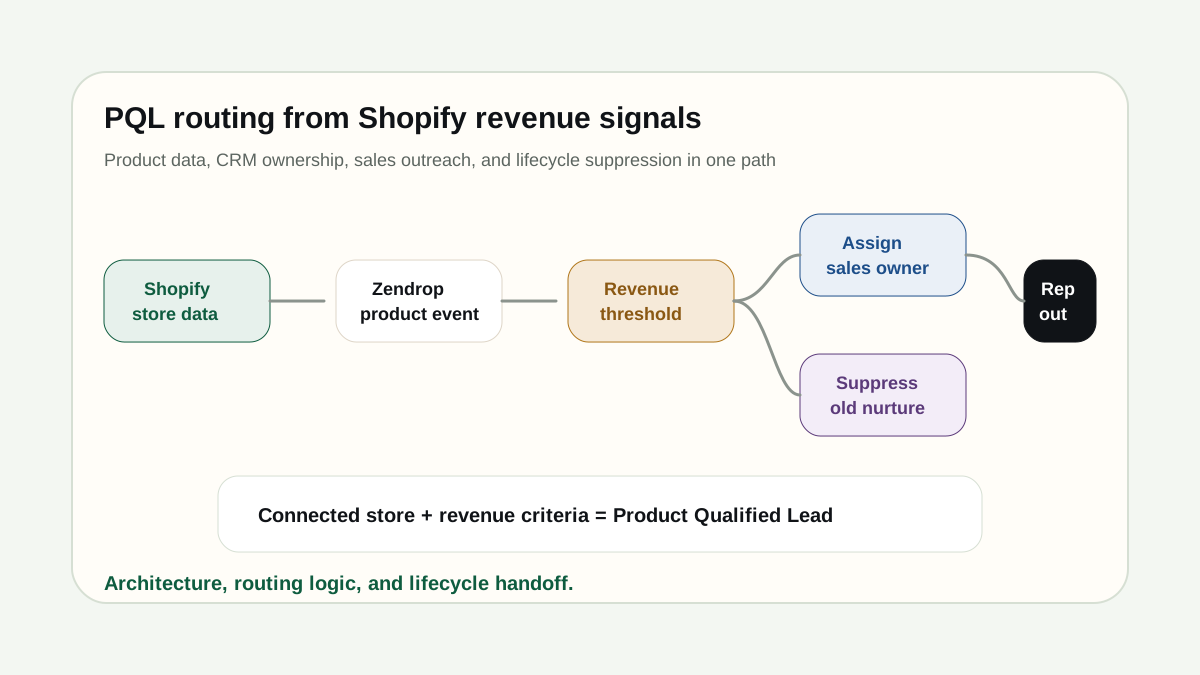
Table of contents
- Introduction
- Business Context
- Business Problem
- Why Traditional Lead Scoring Wasn't Enough
- Solution Architecture
- Shopify to CRM Data Flow
- Product Qualification State Machine
- Sales Routing Architecture
- Automated Outreach Workflow
- Marketing to Sales Lifecycle Transition
- Internal Notification Workflow
- Reliability and Failure Handling
- Engineering Decisions and Tradeoffs
- Lessons Learned
- Closing Thoughts
Introduction
Zendrop had a different kind of sales qualification opportunity because the product connected directly to Shopify.
That meant the company did not have to guess intent from email opens, webinar clicks, or form fills alone. When a merchant connected a Shopify store, Zendrop could see product behavior and store-level business context. That changed the routing model.
This case study explains how I designed an automated product-qualified lead routing system that used Shopify revenue signals and Zendrop product behavior to identify high-value merchants, assign sales ownership, notify the right rep, start personalized outreach, update lifecycle stage, and suppress conflicting nurture.
The work sat between product-led growth, lifecycle architecture, and sales operations. That is the whole point, honestly. Lifecycle decides what should happen when a customer shows real business intent.
Business Context
Zendrop integrated directly with merchants' Shopify stores.
That created a stronger qualification surface than a traditional marketing lead score. A form fill can show interest. An email click can show engagement. A connected store with meaningful revenue can show business potential.
The qualification model could use actual product and business signals:
- The user connected a Shopify store.
- Zendrop received store information through the Shopify integration.
- Store revenue and other qualification criteria were evaluated.
- Merchants who met predefined business thresholds became Product Qualified Leads.
That shifted the system from "who engaged with marketing?" to "who has the product behavior and business profile that makes sales outreach useful?"
Business Problem
The sales team needed to focus on merchants with meaningful business potential.
Without automation, reps would have to identify promising accounts manually or spend time reaching out to merchants who were not likely to need direct sales help yet.
That creates two problems.
First, the best accounts can sit untouched after showing strong product intent.
Second, lower-fit accounts can get pulled into a sales motion too early, which wastes rep time and creates a worse customer experience.
The system needed to solve both sides:
- Identify qualified merchants automatically.
- Route them to the right sales representative.
- Notify the rep internally.
- Send personal outreach from that specific rep.
- Move the customer into the right lifecycle stage.
- Stop nurture that would conflict with the sales process.
Why Traditional Lead Scoring Wasn't Enough
Traditional lead scoring usually starts with marketing engagement.
A user opens an email. They click a campaign. They visit a page. They fill out a form. Those actions can be useful, but they do not always prove business fit.
Zendrop had a better signal available: product data tied to Shopify store context.
For this use case, a merchant connecting a store mattered more than a generic content click. Store revenue mattered more than an abstract score built from engagement events.
The model needed to behave like a Product Qualified Lead system, not a classic Marketing Qualified Lead system.
Weak signal:
opened email
clicked campaign
visited page

Stronger signal:
connected Shopify store
store data received
revenue threshold met
sales owner assigned
The sales handoff had to be based on what the merchant had done inside the product and what the connected store showed about their business.
Solution Architecture
The architecture connected Shopify, Zendrop, the CRM, lifecycle automation, sales notifications, email, and SMS.
Shopify store
  |
  v
Zendrop integration
  |
  v
Store data and product events
  |
  v
Qualification logic
  |
  +-- not qualified -> continue onboarding and education
  |
  +-- qualified -> assign owner -> notify rep -> send outreach -> update lifecycle stage
The key design decision was to treat qualification as a state change.
A merchant did not become sales qualified because a campaign needed more leads. They became sales qualified when product behavior and Shopify business data crossed the agreed threshold.
Shopify to CRM Data Flow
The data flow started when the user connected a Shopify store.
User connects Shopify store
  |
  v
Zendrop receives store data
  |
  v
Store fields update on customer record
  |
  v
Qualification criteria evaluate
  |
  v
CRM ownership and lifecycle stage update
The important part was the order of operations.
The system should not assign sales ownership before the store data is available. It should not send outreach from a rep before that rep has been assigned. It should not keep sending generic nurture once the customer has entered a sales path.
That sequence matters because one broken step can make the whole experience feel automated in a bad way.
Product Qualification State Machine
I designed the logic like a state machine.
State: onboarding
  event: store_connected
  action: import Shopify store data
  next: store_data_received

State: store_data_received
  action: evaluate revenue and qualification criteria
  if qualified: product_qualified_lead
  else: continue_lifecycle_onboarding

State: product_qualified_lead
  action: assign sales owner
  action: notify assigned rep
  action: send rep-based email and SMS
  action: suppress conflicting nurture
  next: sales_engaged
This was cleaner than treating the process like a one-off notification.
The state machine made the dependencies obvious:
- No store connection, no qualification.
- No store data, no revenue evaluation.
- No qualification, no sales routing.
- No sales owner, no rep-based outreach.
- Sales process active, conflicting nurture gets suppressed.
Sales Routing Architecture
Once a merchant met the qualification threshold, the automation assigned the account to the appropriate sales representative.
Product Qualified Lead
  |
  v
Routing rule evaluates account context
  |
  v
Sales owner assigned
  |
  +-- internal notification
  +-- email from assigned rep
  +-- SMS from assigned rep
  +-- lifecycle stage update
The important customer-facing detail was that outreach came from the assigned rep.
That made the handoff feel personal. The user did not receive a generic "someone from our team will reach out" message. They heard from the actual person assigned to them.
Automated Outreach Workflow
The outreach workflow began only after qualification and assignment.
if store_connected == true
and shopify_store_data_received == true
and qualification_threshold_met == true:
  assign_sales_owner()
  notify_sales_owner()
  send_email_from_assigned_owner()
  send_sms_from_assigned_owner()
  update_lifecycle_stage("Product Qualified Lead")
  suppress_conflicting_nurture()
else:
  continue_onboarding_and_education()
The email and SMS were not separate campaigns bolted onto the process. They were part of the routing architecture.
The message source, lifecycle status, suppression rules, and sales ownership all had to agree with each other.
Marketing to Sales Lifecycle Transition
The transition from lifecycle nurture to sales engagement was the part that could break the customer experience if the logic was loose.
Lifecycle onboarding
  |
  v
Product qualified lead detected
  |
  v
Sales process starts
  |
  v
Suppress messages that conflict with sales outreach
That suppression mattered.
If a merchant received a personal SMS from a sales rep and then immediately got a generic nurture email pushing the same action from a brand voice, the system would feel disconnected.
The lifecycle stage update gave the rest of the program a way to respect the sales process.
Internal Notification Workflow
The internal notification acted as a handoff event.
Qualification event
  |
  v
Sales owner assigned
  |
  v
Internal notification sent
  |
  v
Rep sees qualified merchant context
  |
  v
Rep can follow up with product and store context
Sales needed to know why the merchant mattered.
A useful notification should make the next action clear: this merchant connected Shopify, the store data met the qualification threshold, ownership was assigned, and automated outreach has started.
Reliability and Failure Handling
A system like this has a few failure points that need to be handled deliberately.
The store connection can happen before all store data is ready. The qualification criteria can fail because a field is missing. The owner assignment can fail. A rep-based email or SMS should not send if the system does not know who the rep is.
The basic safeguards are straightforward:
- If Shopify store data is missing, do not qualify yet.
- If the merchant does not meet the threshold, keep them in onboarding and education.
- If owner assignment fails, do not send rep-based outreach.
- If lifecycle stage is Product Qualified Lead, suppress conflicting nurture.
- If outreach fails, keep the CRM state clear enough for the sales team to see what happened.
I do not like building automations where every branch assumes the previous step worked. That is how teams end up with customers receiving the right message from the wrong sender.
Engineering Decisions and Tradeoffs
The biggest decision was using product and Shopify revenue data as the qualification foundation.
That created a stronger routing model, but it also made data quality more important. If Shopify data was delayed or incomplete, the system had to wait instead of guessing.
The second decision was to trigger outreach from the assigned sales representative. That made the customer experience feel more direct, but it required ownership assignment to happen before messaging.
The third decision was to suppress lifecycle nurture after sales qualification. That reduced messaging conflict, but it also meant lifecycle had to trust the CRM stage. If the CRM stage was wrong, suppression could be wrong too.
The tradeoff was worth it because the customer experience and sales workflow both depended on a clean handoff.
Lessons Learned
Product behavior is often a stronger qualification signal than marketing engagement.
Email opens and form fills can show interest, but connected product data can show fit. In Zendrop's case, a connected Shopify store with meaningful revenue was a stronger signal than a generic lead score.
Product Qualified Leads also create a better sales motion than broad MQL routing. The rep is not starting from a cold form fill. They are starting from a merchant who took a meaningful product action and met business criteria.
Immediate outreach matters because the context is fresh. The merchant just connected a store. The system has the signal. The assigned rep can reach out while the user still remembers the action that triggered the handoff.
The main lesson is simple: product data should not sit in a product silo. When product behavior, lifecycle automation, and CRM ownership work together, sales gets better accounts and customers get a cleaner next step.
Closing Thoughts
The PQL routing system worked because it treated Shopify revenue signals as lifecycle infrastructure.
Zendrop did not have to rely only on marketing engagement. The product already knew which merchants had connected stores and which stores met the right business criteria.
The architecture turned that data into action: qualify the merchant, assign the owner, notify sales, send personal outreach, update lifecycle stage, and suppress conflicting nurture.
That is the bridge between product-led growth and lifecycle marketing. The product creates the signal. Lifecycle turns the signal into the next right action. Sales gets pulled in when the account is actually worth human attention.
Get one retention idea, every other week
The Lifecycle Letter. One actionable retention idea in your inbox, no fluff, unsubscribe anytime.